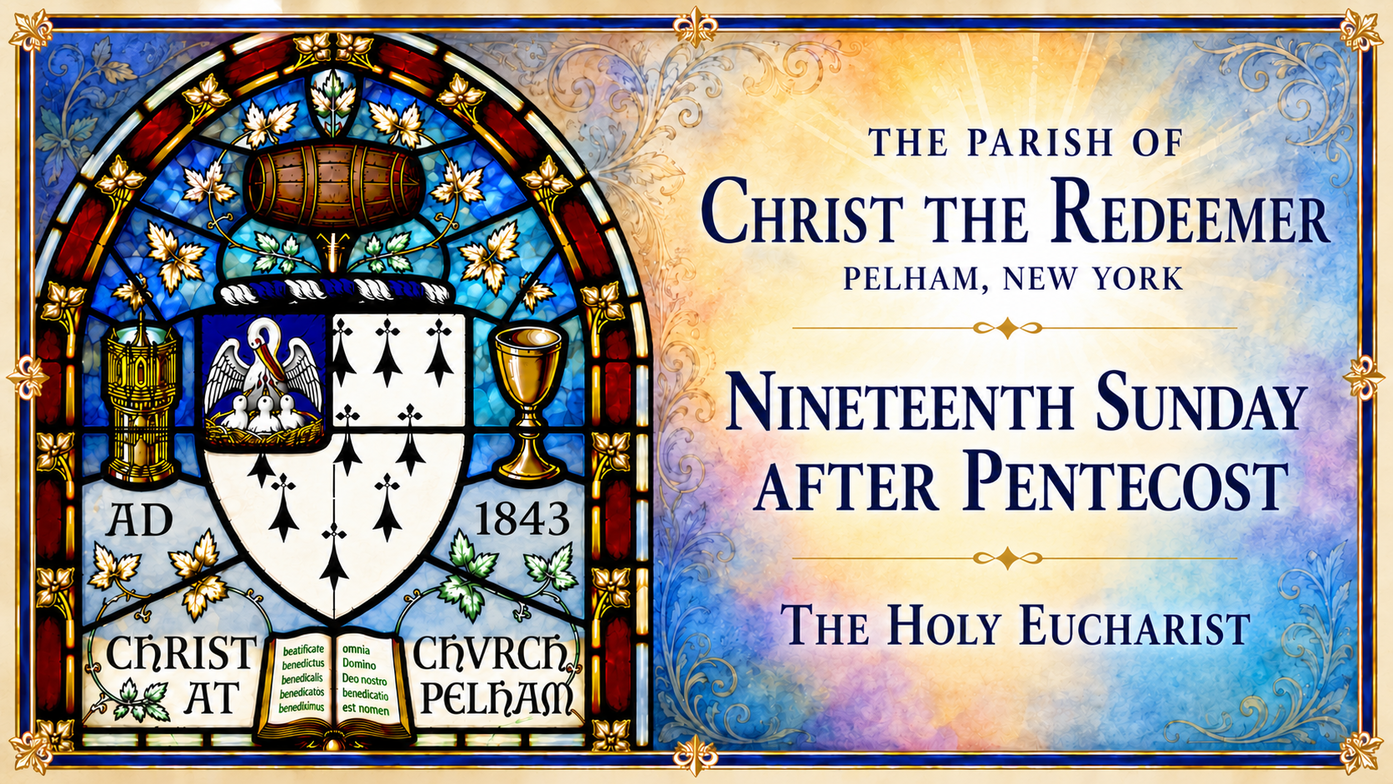
Services & Preacher
- 8:00am: Said Eucharist (Church)
- 10:00am: Choral Eucharist & Sunday School (Church)
- Preacher: Mother Meredith
Events & Fellowship
- 10:00am: Nursery Care (Ranck Building)
- Coffee Hour follows each morning service.
Donate & Give to Support Christ Church
- Donate to Christ Church HERE.
- Our 2026 Pledge campaign has begun. Make you pledge today online. Our goal is 150 pledges for more than $550,000.
- The flowers are given to the glory of God and in thanksgiving for the 20th wedding anniversary of Kari Black and Ed McGann by Marie Dumas.
Livestream Feeds and Bulletins
- A PDF of the 10am Service Leaflet is available below.
- The Livestream link is below.
- Livestreams for all of today's services and all prior weeks can be found HERE.
About Worship Today
- This period in the Church year is known as “The Season after Pentecost” or “Ordinary Time.” The term “ordinary” refers to how the New Testament passages are generally read in order or in sequence, as opposed to being arranged by specific theme as in other seasons. During this season the Gospel passages focus on Jesus’ ministry, how he is revealed to the world as the Christ, and what he teaches to his followers. In Year A (the first in a three-year cycle: A, B & C) most of the Gospel passages are from the Gospel according to Matthew. When Track 1 is used, the Old Testament Lesson is read in thematic sequence throughout the summer, in Year A we will read from the Pentateuch (first five books of the Bible). The New Testament Lesson is independent of these readings and is almost always taken from one of the Letters in the New Testament that reflects the common life and mission of the first Christian community.
- The Holy Eucharist, the principal act of Christian worship on the Lord's Day and other major Feasts, and Daily Morning and Evening Prayer, as set forth in the Book of Common Prayer, 1979, are the regular services appointed for public worship in the Episcopal Church. At Christ Church we celebrate the Holy Eucharist every Sunday, and also on Holy Days and other occasions.
- Today’s liturgy is from the red Book of Common Prayer 1979. All hymns are taken from the blue Hymnal 1982 or other authorized hymnals for use in the Episcopal Church. All hymns are reprinted with permission under OneLicense.net A713125.
- Today's Lessons can be found at the Lectionary Page (Track 1)
10am Service Order:
- Prelude: Meditation by Bischof
- Processional: #397, Now thank we all our God, Nun danket alle Gott
- Gloria in excelsis: S-280, Powell
- The First Lesson: Exodus 20:1-4, 7-9, 12-20
- Gradual: Psalm 19, chant by Samuel Sebastian Wesley
- The Second Lesson: Phillipians 3:4b-14
- Sequence Hymn: #593, Lord, make us instruments of your peace, Dickinson College
- Gospel: Matthew 21:33-46
- Offertory Anthem: O come, ye servants of the Lord by Christopher Tye c 1505-1573
- Offertory Doxology: #380, vs 3, Old 100th
- Sanctus & Benedictus: #S-130 from Deutsche Messe, Franz Peter Schubert (1797–1828); arr. Richard Proulx (b. 1937)
- Agnus Dei: #S-161 from New Plainsong; David Hurd (b. 1950)
- Communion Anthem: Grant unto me by Camille Saint-Saëns 1835-1921
- Postcommunion Hymn: #711, Seek ye first, Seek ye first
- Processional: Symphony No. 3 “Organ” Finale by Saint-Saëns
Prayer List:
- Our prayers are asked for Sean our Presiding Bishop, Matthew and Allen our Bishops, Father Matt our Rector, Mother Meredith, Deacon Chisara, and our Wardens, Officers, and Vestry members. We pray also for: Charles, Sara, Edward, Cathy, Annette, Patricia, M&D, Brian, Marion, Fronda, Coulby, Michael, Jane, and Sandy. We pray for those in our Armed Services. We also pray for those who have died. We give thanks for those celebrating birthdays this week: Jeff Bodenmann (10/8), Glenn Burlingame (10/8), Jesse Cruz (10/9), Margo Hastings (10/7), Albert Kotoloa (10/7), Ed McGann (10/6), Sandra Rivera (10/4), William Scherer (10/7), Barbara Zambelli (10/8).
Dr. J's Notes:
- Camille Saint-Saëns (1835–1921) was one of the most remarkable musical prodigies of the nineteenth century. He began playing the piano at the age of two, and at his celebrated Paris debut at age ten in 1846, he performed works by Mozart and Beethoven from memory. As an encore, Saint-Saëns reportedly offered to play any one of Beethoven’s 32 piano sonatas from memory, allowing the audience to choose. Possessing extraordinary intellectual gifts as well as musical ones, Saint-Saëns became a celebrated pianist and organist, composer, conductor, and scholar. Franz Liszt famously described him as the greatest organist in the world. His vast catalogue ranges from symphonies and concertos to chamber music, opera, sacred choral works, and such enduring favorites as The Carnival of the Animals and the “Organ” Symphony. He served for nearly twenty years as organist of the Church of the Madeleine in Paris, one of the most prestigious musical posts in France. His sacred music combines classical clarity and restraint with the melodic elegance and harmonic richness characteristic of the French Romantic tradition.
Downloads
Worship At Christ Church
Worship Services